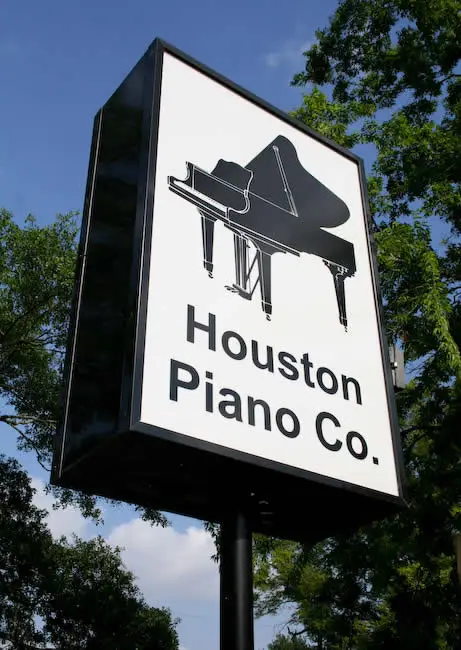
Please join us for this fantastic event! There are two performances one at 3pm and a 7pm.
Limited space ...let us know which performance you prefer. See you there!
RICKY DEE - an evening with Nashville-L.A. recording star
|
< Friday, April 2, 2010
RICKY DEE - an evening with Nashville-L.A. recording star
Dear Friends:
Please join us for this fantastic event! There are two performances one at 3pm and a 7pm. Limited space ...let us know which performance you prefer. See you there! RICKY DEE - an evening with Nashville-L.A. recording star Monday, March 29, 2010
Some Interesting Piano Facts
Some of these we did not even know...Enjoy!
FACT: There are over 12,000 parts in a piano, 10,000 which are moving. FACT: The working section of the piano is called the action. There are about 7500 parts here, all playing a role in sending the hammers against the strings when keys are struck. FACT: Each note in a grand piano has more than 35 points of adjustment. Overall, there are more than 3,080 adjustments for the entire piano. FACT: The range of the piano extends lower than the bottom 16 foot pedal note of an organ and higher than the top note of a piccolo. FACT: The piano is totally complete and needs no assistance from any other instruments, but almost all other instruments need the piano for accompaniment, including singers. FACT: There are 18 million nonprofessional pianists in this country. 79% are female; 21% are male. The average age is 28. FACT: The first practical piano with an escapement mechanism for the hammers with capability of being played softly and loudly was built in 1700 by an Italian, Bartolomeo Cristofori (1655-1731). FACT: The name "piano" is an abbreviation of Cristofori's original name for the instrument: "piano et forte" meaning soft and loud. FACT: One of Cristofori's original pianos is still in existence at the Metropolitan Museum of Art in New York City. FACT: Jonas Chickering was the first exporter of American made pianos. The first shipment was in 1844. FACT: Abraham Lincoln used a Chickering Grand (#5070) while at the White House. FACT: During 1869 the U.S. produced 25,000 pianos together valued at $7,000,000; during 1910 production was 350,000 pianos valued at $100,000,000 ! FACT: A quarter million NEW pianos are bought every year in the U.S. and nearly one million OLD pianos are sold. FACT: The B sendorfer Imperial concert grand piano is 9' 6" long and has 9 extra keys stretching to a growling C below bottom C ! (The Imperial grand sold for $55,000 in 1980!) The 9' and 7' 4" grands have four extra bass keys, the lowest of which is F below bottom C. FACT: The worlds largest piano is a Challen Concert Grand. This piano is 11 feet long, has a total string tension of over 30 tons and weighs more than a ton! FACT: A grand piano action is faster than a vertical (spinet, console, upright) because it has a repetition lever. This allows the pianist to repeat the note when the key is only half way up. A vertical action requires letting the key all the way up to reset the hammer action. FACT: The exact middle of the keyboard is not middle C, it is actually the space between E and F above "middle" C. FACT: The average piano has about 230 strings. Each string has about 160 pounds of tension with a combined pull of all strings equaling almost eighteen tons! FACT: A drop of 1/2 step in pitch can equal a change of 3,000 to 5,000 pounds of tension!. We have been serving the greater Houston area for more than 67 years buying, selling and renting the finest pianos. Come, Stay, Sit and Enjoy! Labels: Houston Piano Company Tuesday, March 23, 2010
Houston Piano Company_ Safety-Ease Dealer
The new online edition of Larry Fine's PianoBuyer.com is up and running on the internet. Many of your piano buying prospects will seek out this valuable information to assist them in deciding which piano to own and where to shop.
The Safety-Ease Lid Assist is prominently featured in a both a full-page animated ad (page 3 of the online book) and a favorable mention on page 113 under "Benches, Lamps, Accessories, and Problem Solvers". http://www.pianobuyer.com/publication.html The buzz is starting and customers are seeking out Safety-Ease dealers. Clicking on our ad sends the prospect directly to our dealer listing page linking to the Safety-Ease dealer. Come, Sit, Stay, Enjoy! Houston Piano Company Labels: Houston Piano Company Monday, March 22, 2010Friday, March 19, 2010
Yamaha Piano Recall
YAMAHA PIANO RECALL
Yamaha has recalled 20,000 pianos due to a problem with the pedal sticking, causing pianists to play faster than they normally would. This has resulted in a number of accidentals. Several near misses have also been reported in the carpal tunnel. The sticky pedal also makes it harder to come to a full stop at the end of a piece, making it risky for audiences and professional reputations alike. Although there have been many accidentals, so far there have been no reported deafs. Currently sales are flat and analysts are waiting to see if current volumes will be sustained or dampened. Experts suggest that Yamaha's response will be the key. Criticism of the company has been sharp, and Congress is planning hearings to find out when Yamaha first learned about the treble. I just thought you might like to know... Houston Piano Company Labels: Houston Piano Company Thursday, December 24, 2009
It’s Never Too Late to Learn: Late-Blooming Pianists Show There’s Always Time to Make Beautiful Music
There are literally thousands of famous pianists out there – from Beethoven and Mozart to Liszt and Chopin to Ray Charles and Elton John – but we thought it might be fun to encourage all you closet pianists out there who might never have done more than dream about playing that it’s never too late by looking at some contemporary artists who have come to piano or music transitions later in life. According to research, musicians, composers, conductors and music teachers all proclaim that the piano provides an invaluable foundation in musicality – no matter what instrument you play, compose for or conduct. So it’s interesting to note that some late-bloomer pianists are those who have migrated from other arts, instruments or fields of music. Let’s explore the path some of these interesting people have taken. Laurence Elder: The Power of Music as Transformation Laurence Elder is a New York City jazz singer/songwriter who almost never became a musician. As a kid, he was kicked out of five schools and ran away from home. As a teenager, he moved onto a tougher path of drugs, vandalism, arson, shoplifting and car theft. At the age of 21, against the odds and in the face of doubt from his parents about his future, Elder totally turned himself around, quitting his self-destructive habits, becoming a triathlete and marathon runner and enrolling in music conservatory with no musical training. He went on to get a Master’s at University of Miami. As a singer and musician, he says he didn’t find his voice until he was 36! He had been a journeyman jazz pianist until then. Elder cites many contemporary virtuosi as major influences in his musical life: Bruce Hornsby for his “piano voicings” and other pianists such as Elton John, Billy Joel, Stevie Wonder and Ben Folds. Mary Kennan Herbert: A Poet Marries Music with Linguistic Artistry for Inspiration Growing up in the Midwest, piano lessons were as common as corn in poet Mary Kennan Herbert’s town, but she absolutely refused to take lessons since the regimen of practice, practice, practice felt to her like a constraining lifeless path of bondage. But as an adult in her twenties, she describes experiencing a sudden desire to learn how to play the piano. Because she was a late bloomer, she signed up for lessons with a woman teacher who had been a late bloomer herself. The teacher gave special attention to hand and finger placement. Although the lessons were a rough road for Herbert, her poems and piano studies have led to numerous collaborations including four of her poems being set to music by Long Island University Music Department Chair, Robert Aquino, in his original work, Hurricane. See www.musicandmeaning.net/issues/showArticle.php?artID=2.8 for samples of her poetry, including the musically-inspired “Piano Lessons.” Hank Jones: 89 Years Young Pianist Makes Jazzy Duets Jazz pianist Hank Jones has been around for a while, having recorded 60 albums under his own name and countless others playing with other musicians, but music critics give one of his latest albums, Kids, recorded with Joe Lovano this year [2009] at the tender age of 89, the highest accolades for musical achievement. While this collaborative duo has made two previous albums together, the critics describe Kids as a “new expressive apex” [www.jazziz.com/reviews/2009/06/20/joe-lovano-and-hank-jones-kids-live-at-dizzy’s-club-coca-cola/] for the pair. The album focuses on the works of Jones’ famous jazz trumpeter brother, Thad. Many people envision their late 80s – if they even get that far! – as likely to be creaky and slow, but 89-year-old Hank Jones is described on this album as having a touch that is “light but never lazy.” He’s been described elsewhere as “eloquent, lyrical and impeccable” [Arnold Jay Smith in "The Impeccable Hank Jones", Down Beat, July 31, 1976]. Elliott Carter: Peaking productivity at 96 Elliott Carter didn’t even come into his musical compositional voice until age 40. Now he’s being noted for coming into his most productive period to date at the tender age of 96. Carter, who is currently the resident composer of the 12th Annual Great Lakes Chamber Music Festival, is known as one of the highest proponents of abstract modernist music in the United States. While his music written prior to age 70 is known for being extremely challenging and difficult to access, the critics say that his best music has been created post-70. Not even octogenarian composers Verdi and Strauss are not considered to peaked so late in their careers as Carter has. Just in the last decade between ages 86 and 96, Carter has composed three major orchestra scores, his first opera, a cello concerto, major substantial pieces for string quartet, oboe quartet and piano quartet, several song cycles and a number of smaller works [www.andante.com/article/article.cfm?id=25614]. He won’t even be attending the Great Lakes Chamber Music Festival because he’s too busy composing a piece for the Chicago Symphony to feature pianist Daniel Barenboim! We’ve showcased four fascinating artisit-musicians who have all used the piano as one of their instruments of expression - a former delinquent drug user, a poet and two mature musicians at ages 89 and 96 - to inspire you closet piano dreamers. With these great examples, there are no excuses of a difficult life, lack of training, more experience or talent in other fields or age to stop you! So come on down to Houston Piano Company, and try your hand. It’s never too late to make music – beautiful or otherwise! Saturday, December 19, 2009
20 Fun Facts About the Piano
Many people play the piano, so it’s easy to take this familiar instrument for granted. So many people play the piano, in fact, that about 100,000 pianos are made per year in the United States alone, and there are about 10 million pianos in American homes, businesses and institutions. And as we wrote last week, many US Presidents have played piano. With a few exceptions, most US Presidents have actually brought their own personal pianos with them to the White House after they have been elected. [See Fun Fact 20 below.] Here are some other fun facts: 1. The name “piano” is actually a shortened nickname from the Italian. The grand piano was originally invented in 1698 by harpsichord maker Bartolomeo Cristofori. He called his invention “gravicèmbalo col piano e forte,” which means “harpsichord with loud and soft” in Italian. That long phrase was shortened to “pianoforte” and then eventually just become “piano.” 2. Some other nicknames for piano playing or the piano are “tickling the ivories,” “the eighty-eight,” and the “black and whites.” These are all references to the structure of the piano. The ivories refer to the fact that the keys were made of ivory until the 1950s. The eighty-eight refers to the number of keys. And the black and whites refer to the two different key colors. 3. The keys of pianos are now made of plastic, but 70% of the instrument is constructed of wood. The cabinets are actually hundreds of pieces of wood securely attached to each other. The hammers and other parts are made of wood, paper, iron, copper, steel and felt. There are about 12,000 parts of a piano, 10,000 of which move to produce sound! 4. Pianos produce sound when a key or keys are struck, which lifts 1-3 hammers at a time to strike a string. 5. There are only two basic types of piano: upright and grand. Uprights are built with their strings vertical to save on cabinet space. Grand pianos are built with the strings horizontal. The longer the string, the better the sound. Within the two categories of upright and grand, there are several varieties. The giant “concert grand” measures 9 feet. The “professional grand” measures 6 feet. The “baby grand” is nearly 6 feet. Within the family of uprights, the standard upright is 51 inches tall or more. The “console” is 42 inches tall. And the “spinet” may just be 3 feet. 6. Grands can actually be played faster than uprights. The hammers on the grand return to their original position than the vertical uprights, thus can produce notes faster. 7. The world’s largest piano is a giant grand at 11 feet, 8 inches long. It weighs over one ton and has a total string tension of 30 tons. Created by the Challen Company, it is thought to be located at a private French estate. 8. The piano is called “the King of the Musical Instruments.” Why? One reason is its sheer size. Another is that it has the largest range of tones, with the ability to produce the deep lows of the Double Bassoon and the highest high note of the Piccolo. Pianos can also simultaneously produce melody and accompaniment within one song. 9. Pianos generally have 220-230 strings. The strings are made of steel and are strung tightly to create the tension needed to produce the sound. They are strung so tightly to about 168 pounds per string, the total tension can equal 18-20 tons. 10. Although pianos are stringed instruments, they are considered percussion instruments and are placed in that section of a symphony orchestra. 11. One of the most expensive pianos ever sold is a Victorian Steinway Grand, which Christie Auction House sold for $1.2 million to the Sterling and Francine Clark Art Institute in Williamstown, Massachusetts. 12. Henry E. Steinway, founder of Steinway Pianos, was actually named Engelhard Steinweg. He Americanized his name in 1853. 13. A new piano should be tuned four times a year with a shift to twice a year after that. 14. One of the first Spinet pianos on record to be produced in the US was in 1742 in Philadelphia. 15. There have been 5000 different brands of pianos available in the market over the last 100 years. 16. Many music schools require at least one semester of compulsory piano study for all music majors, even if piano is not your major. 17. Yamaha was the first Japanese piano manufacturer and started production in 1887. 18. The first note on a standard 88-note keyboard is A. 19. The last note on a standard 88-note keyboard is C. 20. Gerald Ford, George H.W. Bush and George W. Bush are the only Presidents up through George W. Bush’s Presidency who did NOT own a piano. Here are the brands all the other Presidents had [source: Pierce Piano Atlas]: 1st President George Washington Longman & Broderip Harpsichord; Schoen & Vinsen Pianoforte 2nd President John Adams Currier & Co. 3rd President Thomas Jefferson Astor Pianoforte 4th President James Madison Square Grand (name destroyed by fire) 5th President James Monroe Astor Piano 6th President John Quincy Adams Currier & Co. 7th President Andrew Jackson T. Gilbert & Co. Square Piano 8th President Martin Van Buren Hallet & Cumston Square Piano 9th President William Henry Harrison Haines Brothers 10th President John Tyler Thomas Tomkinson Upright Piano 11th President James Knox Polk Astor & Harwood Square Piano 12th President Zachary Taylor name unknown 13th President Millard Fillmore name unknown 14th President Franklin Pierce Chickering Square Piano 15th President James Buchanan Chickering Grand Piano 16th President Abraham Lincoln Chickering Square Piano & Chickering Upright 17th President Andrew Johnson Steinway & Sons Square Piano 18th President Ulysses S. Grant Melodeon 19th President Rutherford B. Hayes Bradbury Upright & Harpsichord (name destroyed by fire) 20th President James A. Garfield Hallet & Davis Upright 21st President Chester A. Arthur Piano cannot be located. 22nd President Grover Cleveland Combination Piano & Harpsichord (name destroyed by fire) 23rd President Benjamin Harrison J. & C. Fischer Upright Piano, Haines Brothers Square 24th President Grover Cleveland Combination Piano & Harpsichord (name destroyed by fire) 25th President William McKinley A. H. Gale Co. Square Piano 26th President Theodore Roosevelt Chickering Upright, Steinway Grand Piano 27th President William Howard Taft Baldwin Grand Piano 28th President Woodrow Wilson Ernst Rosenkranst Square Piano, Knabe Grand 29th President Warren G. Harding A. B. Chase Electric Player Piano 30th President Calvin Coolidge Sohmer Upright Piano 31st President Herbert Hoover Knabe Grand & A. B. Chase Grand 32nd President Franklin D. Roosevelt Hardman Grand 33rd President Harry S. Truman Steinway Grand, Baldwin Grand & Steinway Upright 34th President Dwight D. Eisenhower Hallet & Cumston Upright 35th President John F. Kennedy Ivers & Pond Grand Piano 36th President Lyndon B. Johnson Style L. Steinway, Knabe Console 37th President Richard M. Nixon Geo. P. Bent Upright, Baldwin Vertical 38th President Gerald Ford No personal piano 39th President James (Jimmy) Carter Ludden & Bates 40th President Ronald Reagan Steinway Grand 41st President George Bush Did not own personal piano. 42nd President William (Bill) Clinton Baldwin Grand in the Governor's Mansion. 43rd President George W. Bush No personal piano. Steinway Grand in the White House residence. Labels: 20 Register to receive the HPC newsletter and enter to WIN a FREE PIANO TUNING
Subscribe to |